Monday, September 07, 2015 Road Junkies 0 Comments

CANADA OR BUST, Chapter 26:  
IN WHICH WE GET BACK TO WHERE WE STARTED 
  space  
Days 30 & 31:  St, Joseph, MO to Home
  space  
From St. Joe, our homing instinct had kicked in.  We just drove.  And drove.  And drove.

After a brief overnight in Paducah, we continued east and south toward Georgia, arriving home on day 31.  6,500 miles from when we began, it was time for unpacking.  
   
Canada or Bust

SUNDAY, 6 SEPTEMBER  - MONDAY, 7 SEPTEMBER 2015

2-Day Stats
  • Miles driven:  967
  • Miles walked:  2.5
  • Letterboxes:  1 found
  • Weather:  66° to 91°, clear to partly cloudy
  • Gas:  $2.70 in Sioux Falls, SD, $2.26 in Jasper, TN

Saturday, September 05, 2015 Road Junkies 0 Comments

CANADA OR BUST, Chapter 25:  
IN WHICH WE FIND A CURE FOR BOREDOM 
  space  
Day 29:  Sioux Falls, SD to St Joseph, MO
  space  
The plan for today was just to lay down miles and move east.  We had no sightseeing locations or even letterboxes on our agenda.  We hadn't even been able to scope out any quirky roadside attractions worth a stop, let alone a detour.  Where's the world's biggest     (fill in the blank)    when you need it?
     
With a city population of 168,586 (and a quarter million in the metro area), Sioux Falls is South Dakota's most populous city and one of the fastest growing nationwide.  Before leaving town this morning, we completed the solitary item we had planned—going by Falls Park to see the city's namesake water feature.
    
When we arrived at the falls, we wondered—based on what we learned in Wichita Falls, Texas—whether the Sioux Falls falls were natural or man-made.  The falls tumble over a series of pink quartzite ledges in the midst of a meticulously landscaped park.  So beautiful it looked designed, but it is entirely nature's creation.
   
After planting a letterbox at the park, we left the city a bit after 10 a.m. headed south on I-29, the exact same route we followed three weeks ago on the way north.  In fact, we stayed at the same hotel last night where we had laid our heads in early August and would do so again tonight in St. Joseph, Missouri.
     
Today was quite hot.  Though we often say in the South that the humidity is the problem because it intensifies the heat, this dry blast-furnace heat in the Great Plains can be pretty brutal too.  All too often there are no trees in sight to offer any shade of relief from the sun's insistent rays.
   
Near Lincoln, Iowa, we stopped at Lewis and Clark State Park, where we did find enough shade to enjoy some picnic salads.  Our previous visit to this park was in late October of 2002.  A mere seven weeks later in the year than today's visit, and the weather had been frigid with snow falling.  
    
The afternoon passed as the miles did on I-29—with a rather boring monotony, though we were being well entertained by Bill Bryson's reading of his book A Walk in the Woods, the story of his on-again, off-again hike of the Appalachian Trail.
     
Our ennui was relieved when we chanced to stop in tiny Rock Port, Missouri (pop. 1,318) near the Iowa border to purchase some icy drinks at the local McDonald's.  Walking to the counter to place an order, we saw one customer leaving with his order and no others in sight.  Behind the counter, a frazzled sixty-something clerk, a younger manager whose roots were overtaking her blondness, and an acne-challenged teen boy were slogging through the motions of their respective jobs as a machine frantically beeped an alarm, which none of them appeared to hear.
    
We finally snagged cashier Sadie's attention long enough to order, but before she could initiate the slow process of filling it, a slender, strung-out 30-something guy rushed up to the counter from the side and asked for the manager.  When Sadie wasn't quick enough in persuading her boss to attend to him, the obviously intoxicated guy yelled, "LOOK!  I NEED A PLAIN HAMBURGER STAT!!  I am trying to rescue a dog, and I need it now!"
    
When I gave him my best attempt at a withering look over his gall in delaying the fulfillment of our order, he suggested that I should go outside and see the dog.  Sadie took him more seriously than I did and soon delivered the burger to him, though he made no move to pay before rushing out the door with the burger.
     
After we received our drinks, we sat watching him in the Nebraska-plated Subaru he entered with no sense of urgency.  We have no way of knowing who ate the emergency burger, but in a few short minutes, the car moved to the gas station next door, where the female driver calmly exited the car and the man took an obviously healthy dog for a walk and potty break.
     
Totally entertained by the entire incident in the midst of a ho-hum day, we decided we must plant a letterbox to commemorate this bizarre experience.  Pulling out our resource kit, we found a suitable stamp, put the letterbox together and drove off to find a suitable hiding place.
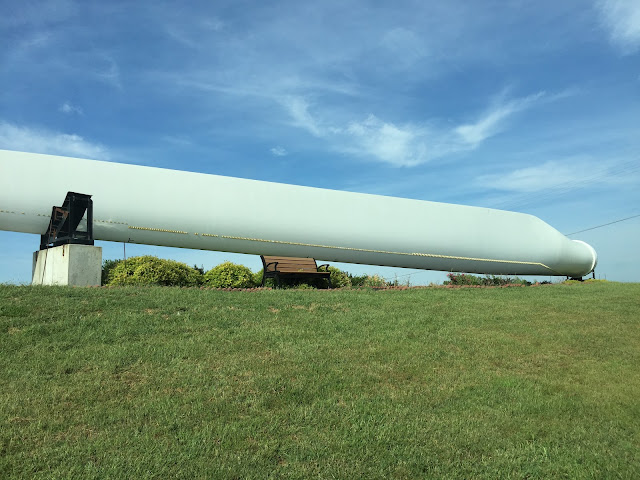
     
A single blade
Having seen some wind turbines when we exited I-29, Ken ventured east of the freeway, thinking we might find a spot for the letterbox near one of the windmills.  It wasn't long before we found an exhibit of a massive wind turbine blade in a pocket park near the water tower for the town of Rock Spring.
   
As we finished preparing the letterbox, Ken asked, "Remember the time we left the interstate to get a closer look at windmills in 2008?  I wonder if that was near here."
   
"Oh, no," I assured him.  "I'm pretty sure that was somewhere in Kansas."
   
Let's put the letterbox near the fencepost.
The letterbox finished, we secured it in its hiding place and took a few photos for clue-writing assistance.  Finally the thought that had been nagging in the back of my mind came to the fore.  Rock Port!  I had seen a clue for a letterbox there.  Sure enough, we found the clue, deciphered the cryptogram, and found the box.  It was very close to where we had just hidden our box.
   
As we logged into that box, another thought was nagging.  "Was this the place we had stopped in 2008?"  Pulling up an old blog post, I found that Ken was exactly right.  There we were in the same exact spot where we had been on September 7, 2008.
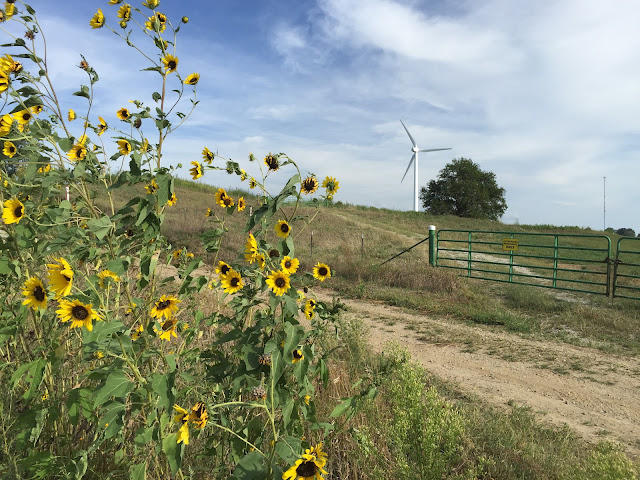
    
Just as in 2008, sunflowers grew near the windmills.
After a good laugh, we began to realize that it must be time to move our travels further afield—to another continent, or at least another country.

Following this bizarre coincidence, there was little to report of the remainder of trip to St. Joe, where we arrived about 6:15, ate dinner, shopped for groceries, and called it a day.

SATURDAY, 5 SEPTEMBER  2015

Daily Stats
  • Miles driven:  342
  • Miles walked:  3.6
  • Letterboxes:  2 found, 2 planted
  • Weather:  72° to 90°, clear
  • Gas:  $2.90 in Sioux Falls, SD

Friday, September 04, 2015 Road Junkies 0 Comments

CANADA OR BUST, Chapter 24:  
IN WHICH WE CROSS THE PRAIRIE AGAIN
  space  
Day 28:  Rapid City, SD to Sioux Falls, SD
  space  
As this trip is winding down, we seem to have finally chanced upon an old strategy.  Get up early and leave early.  Like yesterday, we left the hotel just before 7:00 this morning.  Today we got away that early even after packing up to move on.
    
Of course, the moment we tootled up the ramp and onto I-90 eastbound, that big bright star 93 million miles away glared in our eyes and reminded us of one disadvantage of early departures.  A border of swamp sunflowers lined the highway, their yellow faces happy for the warmth and light from their namesake.
   
With no additional major destinations on our agenda and following routes we've traveled before, our focus for the remainder of the trip will be moving east.  Of course, we'll stop for some letterboxes and a few roadside attractions along the way.  
   
One of the little sub-shops in the massive Wall Drug
First stop today was a place we've seen hundreds of advertisements for and ignored until today.  We finally had reason to stop after someone hid a letterbox at this quintessential "tourist trap"—Wall Drug.  Yes, that world-renowned emporium that began as a humble pharmacy in post-Depression Wall, South Dakota (pop. 873).

A 1929 pharmacy school graduate, native South Dakotan Ted Hosted and his wife Dorothy bought the struggling pharmacy in a remote, foundering town in 1931, vowing to give a five-year commitment to making the business a success before giving up on it.  As their experimental period neared its end, however, an increasing number of Rushmore-bound cars rolled past without stopping.
   
In the torpid heat of July in the dusty Dakota prairie (and remember, this was long before the day of air-conditioned vehicles), Dorothy suggested they try to lure customers in with the offer of free ice water.  Before Ted could finish posting the signs along the highway, Dorothy's brainstorm proved successful, as motorists began pouring into the store.
    
Still a self-promotional champion
The rest is advertising and marketing history.  Wall Drug signs today can be seen for hundreds of miles around.  Rumor has it that American GIs even posted some in Europe during World War II.  (Maybe it was Kilroy!)  From its humble beginnings, Wall Drug has grown into a 76,000-square-foot, block-long collection of stores that attract more than 20,000 people a day in summer.  
   
Nothing bad about this scenery
Named for a rocky nine-mile stretch of jagged ridges that form the northern rim of the Badlands, the town of Wall also serves as the gateway to Badlands National Park.  We entered the park just before 9 a.m. and drove the Badlands Loop Road east through the cones, ridges, gorges, buttes, gulches, and pinnacles that make the area so difficult to traverse.  The very features that led the Lakota Sioux to lebel thee area "makoshika"—the bad lands.
    
Eons of erosion have uncovered these striated formations in the midst of the prairie.  As photo exhibits in the visitor center attested, these monochromatic layers become very colorful when exposed to rain.  Happy to be driving through on good roads in an air-conditioned car on this day with the temp above 90°, we searched in vain for a place to hide a letterbox.  The one box that had been secreted at a scenic lookout seemed to be missing, and we weren't able to leave a substitute.
    
Wild sunflowers grow most anywhere in South Dakota.
Before returning to I-90, we popped in at the visitor center of the Minuteman Missile National Historic Site.  Just opened last year, the center appeared to be still very much under construction.  Exhibits were obviously temporary, and one had to drive 20 miles west to visit the site's features—a launch control facility and a missile silo complex.  We were mildly interested in seeing the silo since my grandfather worked with the U.S. Corps of Engineers on missile silo projects for many years.  But with many miles eastward yet to go, backtracking just didn't work for us today.
     
Finding a shady space to park and eat our picnic lunch proved to be quite a challenge as we drove across South Dakota's treeless plains.  Lacking sufficient rain to sustain trees but with too much to be desert, this long stretch of South Dakota is pure prairie, harboring a nice variety of short and a few tall prairie grasses.  Finally near Murdo, we found a compact little cemetery near the freeway.  A couple of its handful of trees were throwing some deep welcoming shadows across the lane.  So we made some salads and paused for a cool, quiet repast before continuing our eastward drive.
   
This palace may be corny, but it's pretty cool.
Our next stop was the town of Mitchell (pop. 15,539), the proud home of a unique architectural structure—a corn palace.  Back in the late 19th century, small South Dakota farming communities were competing to attract visitors and promote their products.  In this era, almost every town had theaters for traveling vaudeville and other performers.  Often these were designed with a Moorish architectural influence and called palaces, and in this part of the country, a trend emerged of decorating the buildings with the local crops.   Aberdeen had a grain palace; Rapid City, an alfalfa palace; and Mitchell, the corn palace.  
     
With an extensive 2014 facelift and renovation nearing completion, the maize marvel looks better than ever, say the locals.  Each spring local farmers plant special corn to achieve a variety of colors for the murals attached to the exterior walls.  In late August, crews of workers take over 300,000 colorful ears of corn, slice them in half, and nail them into place in a pattern prescribed by a local artist.  Small amounts of other grasses and grains are used for details and borders.  Throughout the winter, the corn palace serves as a giant bird feeder, and come spring, the entire process begins anew.  
         
After Mitchell, we drove the additional 75 miles to Sioux Falls, arriving just before 7 p.m.  Tomorrow, we'll head into the rising sun yet again.

FRIDAY, 4 SEPTEMBER 2015

Daily Stats
  • Miles driven:  378
  • Miles walked:  3.3
  • Letterboxes:  2 found
  • Weather:  72° to 92°, clear
  • Gas:  $3.00 in Box Elder, SD
  • Wall Drug signs:  54
  • Tourists at Wall:  268
  • Sunflowers:  125,892
  • Ears of corn on the Corn Palace:  382,099

Thursday, September 03, 2015 Road Junkies 0 Comments

CANADA OR BUST, Chapter 23:  
IN WHICH WE SEE A STONE FACE, OR TWO 
  space  
Days 26 & 27:  Rapid City, SD 
  space  
We decided to take Wednesday off.  In desperate need of clean clothes, we started the day with laundry. With six washers and six dryers in the Residence Inn guest laundry, we had no difficulty finding space for our things, nor did the family of four that entered the laundry room when we did.
     
Ken took the car out to be washed and gassed up while I caught up on writing in the morning.  Then we ate lunch at Longhorn because it was near a couple of stores where we needed to do a bit of shopping.  
    
Playing off its proximity to Mount Rushmore, Rapid City bills itself as the "City of Presidents." In connection with this the city kicked off a presidential public art project in 1999, largely inspired by people's interactions with an existing Abraham Lincoln statue created by Rushmore sculptor Gutzum Borglum.  Completely funded by private donations, the city installed life-size statues of each of the 43 former U.S. presidents,  Artists who worked on the project strove to create portraits which lent insight into the personality and presidency of each subject.  
     
Lincoln is depicted with his young son Tad.
The statues are placed on sidewalks all over the city so that both visitors and locals are encouraged to explore the downtown area on foot, often posing for photos with their favorite presidents.  We stopped at the Presidents Information Center with its Oval Office interior design.  Grabbing one of the self-guided City of Presidents walking tour booklet, we joined other tourists in the search to see each of the former chief executives.  The brochure helpfully explained why each president was depicted as he was.
   
Benjamin Harrison, who preferred solitude, is depicted feeding birds in his garden.
On Thursday, we were determined to avoid the crowd we expected at Mount Rushmore, so we left the hotel at 7 a.m. for the 40-minute drive.  It turned out to be an excellent time to be there.  Another reason for our early visit was that we had researched the best light for photos of the great carving and learned that early morning was best.
   
Early morning sun highlights all the faces.
After dutifully paying our $10 parking fee, we left our car in the mostly empty lotted entered to find a family of four walking to the plaza ahead of us.  A few photos later we walked to the sculptor's studio and saw Borglum's last model, at which time he still planned to depict the presidents from the waist up.

The docent in the studio related a few interesting stories regarding other changes in the sculpture as the project moved along.  At one time, Jefferson was begun to Washington's right, but the granite in that part of the mountain was too brittle and Tom was moved to George's other side.  In fact, before the carving was finished, Borglum was forced to revise the design nine times to avoid major cracks and other inconsistencies in the rock. 
     
Apparently Borglum had a quick temper and impulsively fired workers for minor infractions or misunderstandings.  His son Lincoln would go into town, track down the former employee and hire him back.
    
A model for one of the iterations of the monument
One who worked on the project a few weeks and got into a fistfight with Lincoln was not rehired.  His name was Korczak Ziolkowski (pronounced jewel-CUFF-ski), and he found another project nearby, one which we'd visit later in the day.
     
Leaving Rushmore, we set out south on the serpentine Iron Mountain Highway, stopping for a couple of letterboxes before a brief stop at Lakota Lake on our way to Custer State Park, with its abundance of wildlife in their natural habitat.  At the park's visitor center, several hundred bison were hanging out on both sides of the road and in the road, an unusual occurrence, according to the ranger we spoke with.  
   
A protest or just being sociable?
We wondered whether the bison might have gathered at the visitor center/administration building to protest next month's roundup time.  With a herd of 1,200, the park sees up to 350 baby bison arrive each year.  An annual thinning is necessary to keep the herd at a size the park acreage can support.
    
From the visitor center, we took the Wildlife Loop Road, looking for both animals and letterboxes.  The people were as interesting to watch as the wildlife.  Despite repeated signs not to feed the animals, a family stopped to do just that—actually to have their children try to feed burros while mom snapped some cool vacay pics.
    
What part of "Don't Feed the Wildlife" was it that you didn't understand?
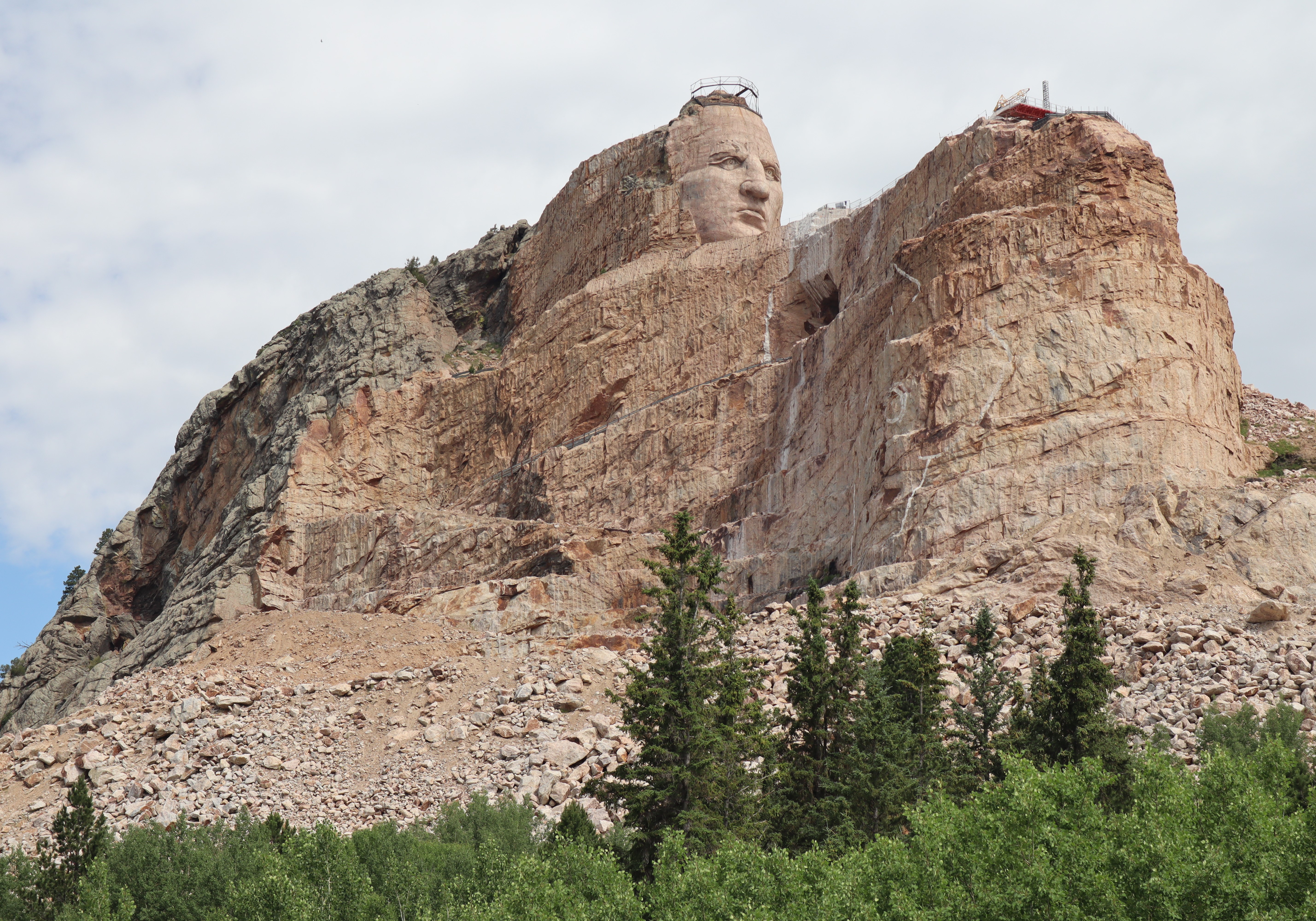
Three hours after our arrival, we left Custer State Park, driving through the town of Custer on our way to visit the Crazy Horse Memorial.  At the invitation of Lakota Chief Standing Bear Korczak Ziolkowski, the Polish-American sculptor booted from the Rushmore project, began work on the Crazy Horse sculpture in 1948.  The sculpture is far larger than the one at Rushmore and does not receive any government funding.
    
Not quite finished
The sculpture is nowhere near completion.  Ziolkowski and his wife moved to the site and had ten children, most of whom have been involved in the massive project.  The father died in 1982, and only sixteen years later was Crazy Horse's face completed.  The endeavor has grown into a multi-million dollar tourist complex that employs more than 100 workers in peak months and uses revenues to fund work on the mountain.
    
When we arrived, numerous tour buses were picking up and dropping off passengers and the parking lot was crowded with cars from all over the United States.  With more than 1.25 million visitors per year, paying $11 each, you'd think a lot of work would be happening.  Yet when we asked an employee about a projected completion date, she excitedly reported that they hope to complete a finger in the next 15 years.
    
The plan in the foreground, the progress in the background
On the way back to our hotel in Rapid City, we stopped for yet another letterbox before dinner at Ruby Tuesdays.  In the morning, we'll start the long trek toward home in earnest, hoping to make it all the way across the wide prairie before tomorrow's nightfall.

WEDNESDAY, 2 SEPTEMBER - THURSDAY, 3 SEPTEMBER 2015

Daily Stats
  • Miles driven:  164
  • Miles walked:  7.8
  • Letterboxes:  9 found
  • Weather:  64° to 95°, sunny
  • Gas:  $3.05 in Rapid City, SD

Tuesday, September 01, 2015 Road Junkies 0 Comments

CANADA OR BUST, Chapter 22:  
IN WHICH KEN SEARCHES FOR FIRE 
  space  
Day 25:  Gillette, WY to Rapid City, SD
  space  
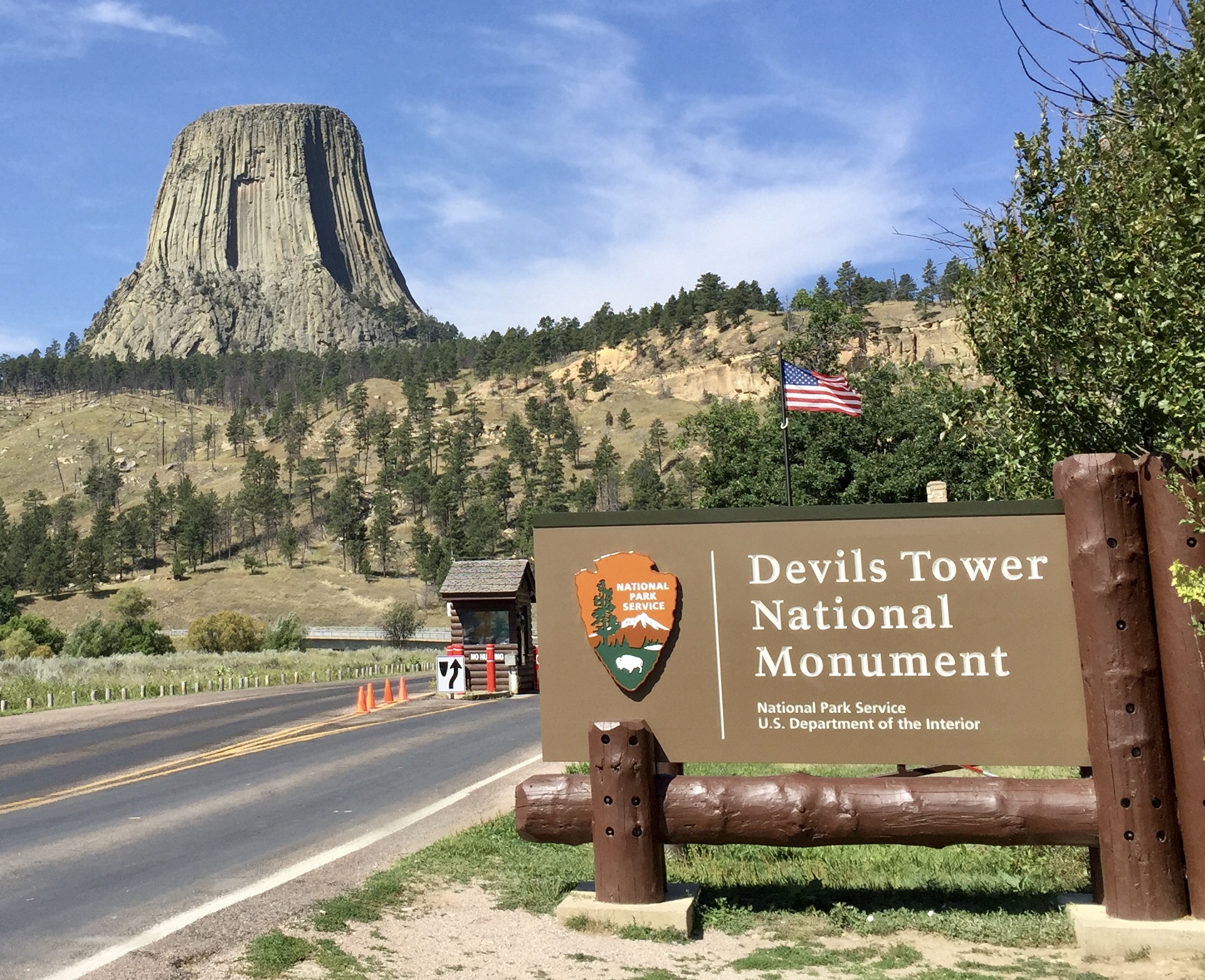
On the way to give the devil his due, we left the Fairfield Inn in Gillette just after 8 a.m.  Devils Tower National Monument would be our first stop.  Named Devils Tower in 1875 due to a misinterpretation of a native name for the area, efforts have been underway for ten years to rename the 1,267-ft rock formation Bear Lodge—the actual Native American name for the monolith.  Sacred to various Native American tribes in the area, the dome was called Bear Home or some variation of that name for hundreds of years.
     
No matter what you call it, it's easily found.
As we approached, we never wondered whether we were going in the right direction because the tower rises so abruptly from the surrounding area.  As we walked the 1.5-mile paved trail around the base of the tower, we observed three groups of climbers ascending.  None was more than about a third of a way toward the summit when we observed them around 10:30.  However, we're confident they made it since more than five thousand climbers from all over the world scale the massive column each year.
    
Prairie dog town
Half a mile from the tower was a prairie dog town along both sides of the road.  As they always do, the little critters were busily popping out of their holes, scouting the vicinity, and popping back down to share what they'd seen.  A half dozen cars were parked in a layby when we pulled over, all watching the little rodents from their vehicles.
    
Several of the critters approached a car from North Dakota begging for a handout, but those residents of the Great Plains knew better than to be lured in by the cuteness.  Just as we were driving away, a busload of foreign tourists were exiting their coach into the pullout.  Goodness only knows what kinds of treats they served up to the little ones.
     
On the way up to visit Ranger Karen
Ken loves exploring forest service roads, and the area around the tower is crisscrossed with many.  After two park rangers discouraged us from attempting an unmaintained gravel road that climbed deep into the Black Hills National Forest, we took a paved forest service road to the top of Warren Peak (elev. 6,696), where we found two letterboxes and Ken climbed to the top of the fire tower to give Ranger Karen a break from her solitude.  Half an hour later he escaped and we moved on to the smudge on the map labeled Beulah (pop. 33), where we found a letterbox at the old one-room schoolhouse.  
     
Bidding a fond farewell to the scenic Wyoming, we crossed into South Dakota on I-90.  Chasing letterboxes, we exited south on US-85 and drove into Deadwood, the gambling mecca where every hotel has a casino and every casino has a hotel.
     
Deadwood's Main Street
We found a letterbox outside the local library and drove to the cemetery where Wild Bill Hickock and Calamity Jane are buried.  The letterbox hidden there was inaccessible today so we were leaving when a tall, friendly, silver-haired tourist noted our Georgia license plate and noted that he lives north of Atlanta.  A couple of sentences later we had reached two degrees of separation when it was revealed that, while a professor at Georgia State, he taught one of Ken's fraternity brothers in the 1970s.  Two more letterboxes near Deadwood and we finally had lunch about 4 p.m. at a National Forest Service picnic area atop Mount Roosevelt (named for TR, of course).
    
Is Sturgis ever motorcycle-free?
After seeing all the bikers moving across the country last month on their way home from one the world's largest motorcycle rallies, we wanted to check out Sturgis, this town of 6,883 people that can handle a guest list up to one million.  A month after the big event, the town appeared business-as-usual calm.  Yes, there were more tattoo parlors and motorcycle shops per city block than the average American metropolis.  But today things were quiet enough for us to stealthily find one letterbox and confirm the missing status reported on another.
     
One final letterbox in a rural cemetery near the wee village of Piedmont (pop. 222) and we called it a day as we rolled into the parking lot for the Rapid City Residence Inn.  Tomorrow we continue east toward home.

TUESDAY, 1 SEPTEMBER 2015

Daily Stats
  • Miles driven:  215
  • Miles walked:  4.4
  • Letterboxes:  10 found,
  • Weather:  60° to 86°, sunny
  • Canada geese:  too many
  • Wall Drug signs:  39
  • Pronghorns:  164
  • Prairie dogs:  87
   
A closer view of Devil's Tower