Friday, January 08, 2016 Road Junkies 0 Comments

Our travels in 2016 were focused on North America, and we pushed the compass to its limits and visited some spots that have long been on our travel radar.  In the process, we managed to log another 30,000 miles on our poor old 5-year-old SUV.
    
We began our travels driving south, as far south as we could go in the U.S.—to the Florida Keys.  We even went beyond Key West to visit a remote national park.  
   
In the spring, we decided that we wanted to move away from Peachtree City.  Though it had served us well for 13 years, it was time for a change.  Our search took up most of April and May as we explored various areas north of Atlanta before deciding on a single family rental house in Alpharetta, where we moved in July.  Meanwhile, we carved out a week in the Pacific Northwest in June as we searched for relief from the Georgia heat.

As soon as we were unpacked, we headed back north to visit the three Canadian territories—Yukon, Northwest Territories and Nunavut.  We traveled by regional jet between the capital cities of these vast wild lands and thoroughly enjoyed the journey.  In fact, we had so much fun up north that we traveled to Alaska in September and spent three weeks road tripping around America's last frontier.

By November, we were ready for coast to coast road trip, so we followed US-80 from Tybee Island, Georgia to San Diego.  Following lots of back roads, we looked for opportunities to meet and interact with our fellow Americans.

In between travel, we built in lost of quality time with family and friends in 2017.  We helped celebrate joyous occasions like cousin Jean's 90th birthday, friends' retirements, and a momentous anniversary for Sunbelt Marketing.  But there was sadness too.  Our family was devastated when Uncle Joe and Uncle Jim passed away just two months apart.  It was a terrible loss for the entire extended family.

We visited Yellowstone with Steven and Nanamama, and we attended Jimmy Carter's Sunday School class in Plains, GA, with Steven and Kathy.  We started a new tradition we call Meals on Wheels—inviting family and friends to meet us for lunch or dinner at a restaurant of their choice in their town, affording a better opportunity to catch up with individuals than at large family gatherings where there's never enough time to talk in depth with each person.  It was a rousing success, and we hope to expand Meals on Wheels in 2017.

2016 Summary

Major Trips
  • Gaelic Getaway  (December 1-January 6).   Finishing up a two-country road trip begun last December.
  • All Keyed Up  (March 9-16).  An exhilarating two-week exploration of Newfoundland and eastern Labrador.
  • Meals on Wheels  (March 27-April 3).   Visiting family and friends in the Southeast to share a meal in their town.
  • North by Northwest  (June 2-9).  A week in Vancouver and northwestern Washington state for cooler temps.
  • Seeking True North  (August 16-30).   A visit to the Canadian territories.
  • Alaska Adventure  (September 12-29).  Flitting up the Inner Passage by air, road trip in the center, and a flight way up north to Barrow.
  • Yellowstone Again  (October 10-14).   Flew to Montana to visit Yellowstone with Nanamama and Steven.
  • From Sea to Shining Sea  (November 13-January 1).  A 45-day transcontinental road trip along the Old Dixie Highway, US-80, from Savannah to San Diego.

States We Visited in 2016

  1. Alabama
  2. Alaska
  3. Arizona
  4. Arkansas
  5. California
  6. Florida
  7. Georgia
  8. Louisiana
  9. Minnesota
  10. Mississippi
  11. Montana
  12. New Mexico
  13. North Carolina
  14. Oklahoma
  15. South Carolina
  16. Tennessee
  17. Texas
  18. Washington
  19. Wyoming

 space 

 space 

Canadian Provinces & Territories Visited in 2016

  1. British Columbia
  2. Northwest Territories
  3. Nunavut
  4. Ontario
  5. Yukon

Countries We Visited in 2016

  1. Canada
  2. Ireland
  3. United Kingdom (Scotland)

Other Events in 2016

  • January -Shoe Shopper trip to Orange Beach (Dianne)
  • January - Jean's 90th birthday
  • January - St. Augustine to help care for Uncle Joe
  • February - Uncle Joe's funeral
  • February- Jimmy Carter's Sunday School class with Kathy & Steven
  • April-June - Townhouse hunting
  • May - Uncle Jim's funeral
  • October - Uncle Joe's memorial in Millry

2015 in Review

Thursday, January 07, 2016 Road Junkies 0 Comments

After the year ended and we finished our Gaelic Getaway trip to Ireland and Scotland in early January, it was time for a look back at 2015.  Yes, we knew the weather wouldn't be all blue skies in December, but we definitely did not expect all the severe storms and flooding in both countries.  
    
As we review our calendar, we relish memories of some minor trips and other events which helped define the year though they didn't find a place in our blog.  In a continuation from December of last year, we spent the first half of January at our favorite winter beach—Perdido Key, on the Florida panhandle.  The chill in the air keeps the sun lovers away and leaves the beach just the way we like it—empty and with no risk of sweating.
   
When yours are the only footprints on the beach
In early January, we gathered for the unveiling and dedication of the extraordinary black granite marker for Woodie's grave.  Of course, Kathy laid plans to make it a special event, and family members gathered to remember Woodie and commiserate in our grief over his absence.
   
Steven, Kathy & Rachel with Woodie's marker, which is exactly his height
As soon as we returned from Perdido in mid-January, Dianne headed to Savannah with her shoe shopping friends for another girlfriend getaway in an historic Savannah home for the MLK holiday weekend.  In four days, they walked and talked and letterboxed and drank.  They ate and shopped and hunted ghosts and drank and played endless rounds of games, especially their favorite—Fictionary!
   space 
Shoeshoppers ready to play (L to R):  Karen, Cathy, Dottie, Diane, Mary & Tina
Still in January, we drove all the way to Cincinnati to visit a cemetery.  Spring Grove Cemetery and Arboretum was founded in 1844 to provide a nondenominational burial ground for a city besieged by a cholera epidemic.  Its establishment was initiated by the Cincinnati Horticultural Society, and it was conceived as a park as well as a burial ground.  But, as beautiful as it is, we probably wouldn't have driven 500 miles just to take in the cemetery, had it not been a hotbed of letterboxing.  In three days, we found 100 boxes within Spring Grove, not nearly the total number.
   
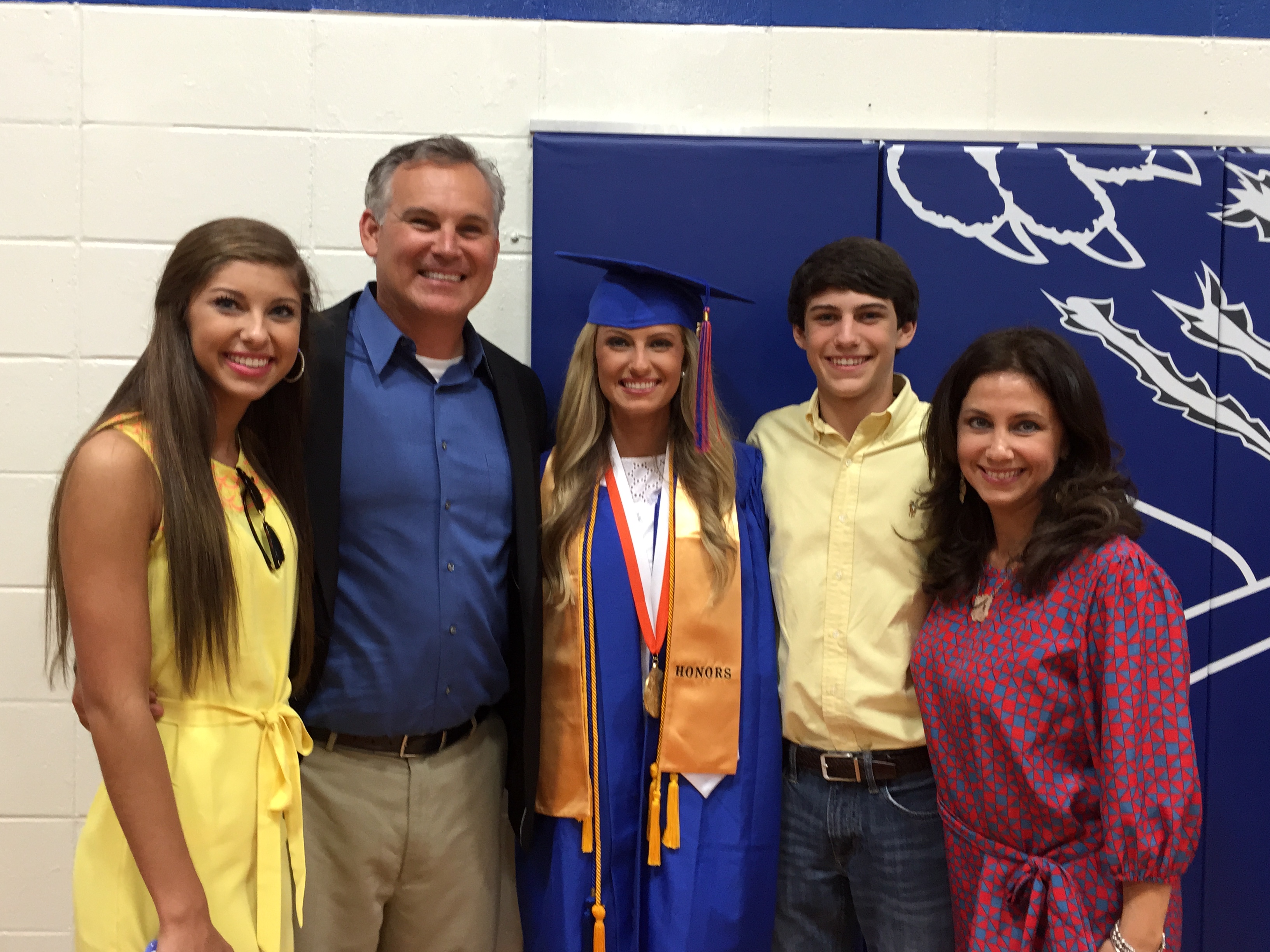
The extraordinary graduate with her siblings and parents
Spring Grove administration building
Even more interesting than the letterboxing were some novelty flower arrangements we chanced upon in the cemetery.  From these creative displays, we were able to learn a lot about the recently deceased.  Franny was someone's beloved mom and aunt who liked shopping on eBay, listening to her iPod, wearing Toms shoes, washing with Tide, talking on the telephone, drinking Pepsi, and eating at Chick-fil-A.  By the huge number of arrangements of all types, this lady will be missed by many people.
  
Just a few of the floral creations in Franny's memory
February found us headed back to Alabama for a short visit with both Uncle Joe and Uncle Jim and their charming wives Eleanor and Dean in town.  On the way down, we stopped at the Alabama State Capitol, which we have never visited, though we've driven through Montgomery innumerable times.
      space 
Alabama State Capitol
Designed in the Greek Revival style so popular with state capitol buildings, the Alabama statehouse underwent a major renovation in 1992, restoring it to its original 1850s appearance.
   
May brought Karoline's high school graduation in southeast Alabama.  One of the most organized and resourceful individuals we know, Karoline worked diligently and secured funding for her college education by cobbling together a combination of scholarships and grants to cover the cost.  We couldn't have been prouder or more impressed.
   
Heather and Dan and their respective children
Another life event in September brought family together to celebrate the wedding of Heather and Dan in North Carolina.  In an unlikely coincidence, this blended family now has two twelve-year-old Emmas.  They've already figured out how to reduce confusion by that tried-and-true school method of adding a last initial.
   
Uncle Joe and son-in-law Steve
In October, we spent a week with Uncle Joe and Eleanor in St. Augustine.  Due to his cancer treatments, Uncle Joe's health has declined significantly and he needs assistance with some activities of daily living.  His daughters have been taking turns being with him, and we were glad to jump in and spend some quality time with this lion of the family, whose sense of humor was definitely still intact.
    
Avery explains the tractor operation to Layson. (or maybe it was just a photo op)
Between our other trips, we squeezed in the opportunity to spend Thanksgiving in Alabama with family.  Much of sister Jeanne's family was there, as well as Woodie's.  And we were so glad we went, as the long talked about barn dance finally happened with Alex and Steven as deejays.  It was all we had hoped for and more.
   
Jeanne and Dianne had talked about having a barn dance for 50 years.
After returning from the family Thanksgiving, we flew off to Ireland to end the year.  In addition to our travel adventures in 2015, we relished the times we spent with family and friends.  We're looking forward to more of each in 2016.

Wednesday, January 06, 2016 Road Junkies 0 Comments

GAELIC GETAWAY
, Chapter 29: 
IN WHICH WE BID FAREWELL

Days 35-37:  Edinburgh to Dublin to Home

Monday, 4 January—Edinburgh

For the third consecutive day, we visited a post office to mail a card and found it closed.  Apparently this is the "substitute" bank holiday for January 2 because it occurred on Saturday—and was also a holiday.  So interesting.

We walked on to the National Museum of Scotland, arriving just after 10 a.m.  Admission was free, and we were given a brochure with a floor plan, which indicated there were actually two museums.  Somehow we started in the middle of an exhibit and struggled to make heads or tails of it.  
  
Obviously, some curator decided to maximize confusion.  And it worked!
Signage didn't help as it was unnecessarily confusing.  Even when there was space to do otherwise, one had to find the number of an item on display, look somewhere else for the description of it, and yet another place to figure out the estimated date of the item.  
  
And let's get the kids playing next to patrons studying exhibits.
Like a museum we had visited in Glasgow, displays and activities for children were interspersed with the primary exhibits.  It all just felt like a muddle, and we were glad to leave when a docent helped us find our  way to the exit after a torturous hour.
   
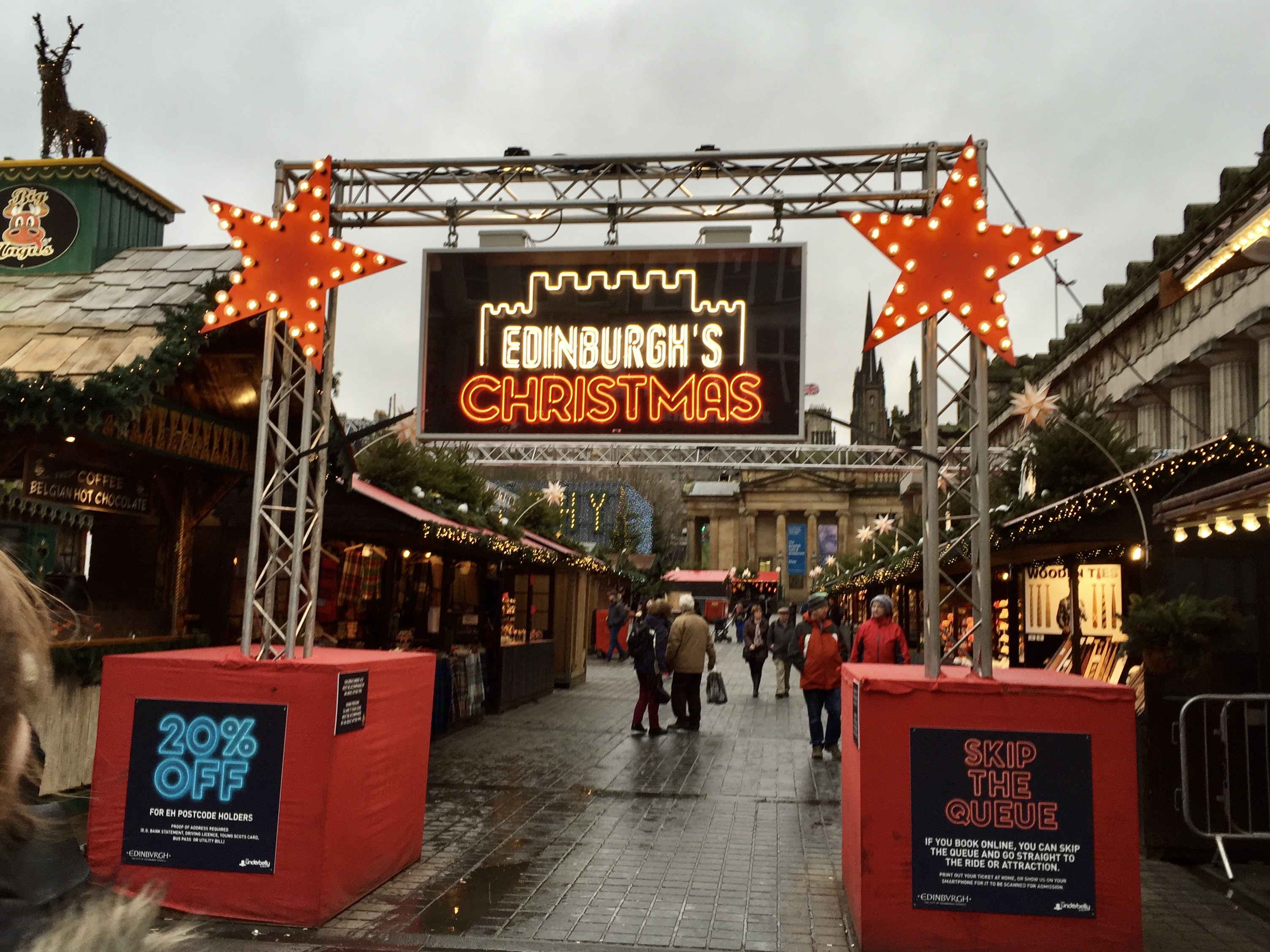
Christmas market
After our escape, we finally went to check out Edinburgh's Christmas market at Princess Street Gardens.  All manner of vendors were on hand—some to sell you gifts, others to keep your hunger and thirst at bay. The market was still quite busy on this last day.  Kids' school holidays extend from December 23 to January 5, so there were plenty of families enjoying the activities.
  
Vendors hope post-Christmas discounts will move a bit more inventory.
We passed on the fair fare in favor of one last meal at Henderson's on Hanover Street.  I couldn't resist having the vegetarian haggis again and Ken enjoyed a veggie lasagne with salad before we walked to the National Gallery, which also offered free admission.  When we saw a sign near the entrance proclaiming Room 1:  Begin Here, it was already an improvement from the National Museum.
   
Portrait of a Man (artist unknown), c. 1520-25
Room 1 housed mostly 16th century paintings, oil on panel.  Many had undergone restoration and cleaning with amazing results.  The detail and clarity on some of the paintings made them look like high resolution photographs.  Many of the paintings were commissioned works that once hung in churches and chapels.  Biblical scenes often included the benefactor's image in the painting.  It was an interesting collection in a well-organized museum.
  
Lamentation of Christ with a group of donors (artist unknown), c. 1518
Our final museum of the day was the National Portrait Gallery.  We have thoroughly enjoyed museums of this type in London, Washington, and Canberra.  The Scottish version was no exception.  An imposing neo-Gothic red sandstone palace designed as a shrine to Scotland's heroes and heroines, the museum opened in 1889 as the world's first purpose-built portrait gallery.  The building's exterior is adorned with thirty-one figures from Scottish history with William Wallace and Robert the Bruce guarding the entrance.
   
National Portrait Gallery
Any visitors who aren't suitably impressed with the architecture of the exterior will be dazzled upon entry with the elaborately decorated Great Hall.  A colorful frieze lining the first-floor balustrade offers a parade of key figures in Scottish history, including Mary Queen of Scots, Robert Burns, David Livingstone, and Adam Smith. Upstairs, large-scale murals adorn the walls, depicting important chapters from Scottish history.

Great Hall, National Portrait Gallery
Through a wealth of imagery including paintings and sculptures, the museum relates many aspects of the story of Scotland and her people—from historic and literary figures to modern scientific pioneers.  We found it to be a superb collection and experience and had to drag ourselves away after an hour and a half.

Fittingly, rain was falling when we left the gallery and walked to Princes Street, through Princes Mall and Waverly train station to Market Street.  Down a few short yards, we walked to the Doric for dinner. As when we visited this historic establishment previously, the food was delicious and the service friendly.  By the time we left, the rain had paused, so we walked through Advocate's Close to High Street, out the George IV bridge to Forest and back to the Residence Inn.  

Tuesday, 5 January—Edinburgh to Dublin

With a 2 p.m. flight to Dublin, we had plenty of time to pack and make our way to the airport without rushing.  After returning our rental car to Hertz, we walked 15 minutes in the rain to the terminal.  The hour-long Ryanair flight was unremarkable except for the rain at both ends.  This wouldn't have been a concern with a conventional airline but since Ryanair is a budget provider which doesn't usually rent a gate with a jet bridge, we had to deal with wet air stairs and a puddling tarmac at departure and arrival.
   
Fittingly for this trip, we had rain in both Edinburgh and Dublin.
A friendly Dublin taxi driver delivered us to the nearby Crowne Plaza hotel, where we had dinner and fell into bed early in preparation for a long flight tomorrow.

Wednesday, 5 January—Dublin to Home

After a taxi back to the airport, we were prepared for another confusing security screening.  Fortunately, we found better conditions.  Signage made the requirements clear—remove belt, shoes, hat and jacket, take liquids and electronics out of bags and into a tray.  All went smoothly.  So why did we need to go through a second identical complete security screening as part of "USA PreClearance"?  We did have a tiny concession with Global Entry as far as the passport line after the screen.
  
Deja vu:  Clearance #2
But wait, there's more.  When we were ready to board, we were hassled at the gate on the way to the jetway because the Delta agent failed to attach a security clearance sticker on our passports when we started there for check in.  

With no direct service from Dublin to Atlanta, Delta dropped us off at JFK in New York for a one-hour layover before our short flight home to Atlanta which arrived about 6 pm.  We had a text from our faithful Around Atlanta driver as soon as we landed.  He was waiting and drove us home.
   
Our Gaelic Getaway
Though we weren't able to visit all the places we had hoped to see, we did learn a valuable lesson about Gaelic winters—not a good time to visit.  Only after we began experiencing the weather did we seriously study the latitudinal location of these countries.  The most surprising fact we learned was that Scotland's northernmost point is farther north than southern Alaska.  Needless to say, when we return to see the places we missed, it will be at a different time of year.

MONDAY, 4 JANUARY - WEDNESDAY, 6 JANUARY 2016  

Sunday, January 03, 2016 Road Junkies 0 Comments

GAELIC GETAWAY
, Chapter 28: 
IN WHICH WE FLIPPED

Day 34:  Edinburgh 

Gray clouds, our familiar companions, were hovering over Edinburgh and a brisk wind was blowing when we left the hotel this morning. Rain was not in the forecast until noon, but the clouds promised something different.  

Our first stop of the day was at Linlithgow Palace, birthplace of Mary, Queen of Scots, and her father, James V.  By the time we arrived, we realized that we didn't have time to explore much and still get to our next stop in time for our 11:30 appointment.  
  
St. Michael's Parish Church
Instead of visiting the palace, we spent a few minutes in the majestic St. Michael's Parish Church next to the palace.  When we arrived, ushers were already in place for the 11 a.m. service and all seemed well versed in the church's history.  Ken chatted with Chester while I walked around taking a few photos.  
  
High altar, St Michael's Parish Church
Consecrated in 1242,  the church was largely destroyed by fire in 1424.  After a century of construction the current church was completed in 1540.  Just two years later, after Mary, Queen of Scots, was born next door, she was baptized there.  One of the ushers pointed to lingering signs of damage inflicted when the church was occupied by Oliver Cromwell's forces in 1646.
  
St Catherine's Aisle, St Michael's Parish Church
Ten miles west on A-803 took us to the location of our morning appointment—the Falkirk Wheel.  Like our train trip through the Chunnel in 2011 (it's light, it's dark, it's light again), this newer example of an engineering marvel was a bit better in concept than the actual experience proved to be.
  
Boat entering lift at lower level
Back around the turn of the century, the UK Millennium Commission decided to restore and reopen the historic canals of central Scotland to provide a water route between the east and west coasts.  As it had when the canals were active more than 100 years before, the connection between the Union Canal and the Forth and Clyde Canal presented a challenge.  At their connection point, the two canals differ in height by 115 feet.  

Before the 1930s, the connection between the two had been accomplished with the use of eleven conventional locks, which took an entire day to transit.  The locks had been dismantled in 1933 after they went out of use.  Enter the Falkirk Wheel engineering marvel.  Using the force of gravity and Archimedes' principle, a lift was designed to transfer boats from one level to the next in about 15 minutes.
  
Gravity helps boats switch places
The Wheel comprises two huge, balanced water tanks suspended on arms which rotate around a central axis.  Each tank can support up to four 65-foot-long boats at one time. When boats move into the tanks through the lock gates, a mass of water from each tank equal to the weight of the vessels is displaced. The tanks are thus always equalized in weight, allowing the pull of gravity on the descending tank to do most of the work elevating the rising tank.  For tourists, the boat ride takes passengers through the entire cycle, from bottom to top and back to bottom.  Though the science was interesting, the boat ride was underwhelming.
   
Since we were only five miles away, we drove from the boat lift to the Helix, a park created to be the home of the self-proclaimed largest equine statues in the world.  In Scottish folklore, a kelpie is a mythical shape-shifting creature that inhabits lochs.  Featured in tales about most every sizable lake in Scotland, kelpies are often described as a horse-like creature.  The most famous kelpie legend is that of Nessie, the so-called Loch Ness monster.
   
The Kelpies
Standing at 100 feet tall and weighing 300 tons each, the Kelpies at the Helix park are two enormous horse heads created by artist Andy Scott.  Modeled after two real-life Clydesdale horses, the sculptures were commissioned as a monument to Scotland's horse-powered industrial heritage.  Like the Falkirk Wheel, the Kelpies were drawing a big crowd today.
   
The image that guided sculptor Andy Scott
Leaving the equines at quarter past two, we returned eight miles east on the A-9 to Linlithgow Palace.  After paying our senior admission fee, we walked into the shell of the palace overlooking the loch.  Designed in a quadrangular arrangement with four ranges around a central courtyard, Linlithgow was built and developed over the course of two centuries by Scotland's Stewart monarchs.  The palace offered a comfortable retreat between Edinburgh and Stirling. 
   
Linlithgow Palace
In 1603, the kingdoms of England, Scotland and Ireland united when James VI, King of Scots, inherited the crowns of England and Ireland and moved his court from Edinburgh to London.  With no monarch in residence in Scotland, the palace fell into decline until the early 1800s when conservation efforts were begun.  Maintained today by the Scottish government, the stunning palace ruins still have the power to inspire awe.
   
Great Hall, Linlithgow
Though it is now only a shell, the Great Hall still has the power to inspire awe.  This was the space used for important gatherings and events.  Tapestries would have adorned the walls, statues displayed on plinths around the enormous room.  Banquet tables, laden with fine china and silver, would have encircled the room with the king's table near the massive three-bay fireplace so that he and his party would be warm.  Now only ghosts inhabit the palace.
  
Finally tearing ourselves away from the magical spell of Linlithgow about 3:30, we hopped in the car to drive four miles (20 minutes) to the wee village of Blackness (pop. 135).  It was established on the shores of the Firth of Forth in 1389 as a port for Linlithgow.  In the 1440s, Blackness Castle was built on an outcrop of rock on the shore to protect the harbor.  Over the centuries, it has been fortified, sieged, repaired, rebuilt, and refortified a number of times.  The castle has served variously as a prison, an ammunition depot, and a military garrison until it was finally decommissioned in 1912.
  
Blackness Castle
We arrived a bit too late to really explore this historic site and were shooed out the gates at the 4 pm closing time.  The twenty-mile drive back to the Residence Inn in Edinburgh took the better part of an hour.  When we arrived in utter darkness, we were convinced it must be close to midnight though it was only 4:50 pm.  On our last day in this charming city and in Scotland tomorrow, we plan to explore some local museums.

SUNDAY, 3 JANUARY 2016  

Saturday, January 02, 2016 Road Junkies 0 Comments

GAELIC GETAWAY
, Chapter 27: 
IN WHICH IT'S A DOGS' LIFE

Day 33:  Edinburgh 

Back in our Edinburgh home away from home, we still have a couple of days to visit nearby locations before our flight home next week.  Our first stop this morning was Craigmillar Castle, just four miles from the hotel.  One of the best preserved medieval castles in Scotland, Craigmillar is best known for its association with Mary, Queen of Scots, who convalesced there after the birth of her son James.  
  
Craigmillar Castle
Arriving a bit before the 10:00 opening time, we strolled around the grounds and found a discreet place to hide a letterbox in an old wall.  Having finished that project, we returned to the entrance to find it still locked up tight.  Chatting briefly with an Australian couple, we discovered that they, like us, had depended on Google for opening times.  Consulting the property's web site, we discovered that it was closed today because January 2 is a bank holiday in Scotland.
   
The hike to Arthur's Seat
Hiding a treasure in the wall
Moving on, we drove to Calton Hill and parked near the Parliament building.  We walked up to the Old Calton Burial Ground at the top of the hill and revisited the Stewart Monument as well as the National Monument and the Nelson Monument.  Our primary purpose was to search for a likely home for a new letterbox, but we found no place suitable.
  
Unassuming but top notch
From there, we finally made our pilgrimage to Henderson's, the institution of a vegetarian restaurant that opened in 1962.  As when we ate there in 2011, the legendary basement bistro was bustling with customers eager to try some of the cutting edge vegetarian cuisine that has earned Henderson's an international reputation.
  
Love those neeps and tatties
I couldn't resist ordering the vegetarian haggis again.  It was served with clapshot, a tasty mixture of bashed neeps (rutabaga) and champit tatties (mashed potatoes), both topped with a delicious spicy sauce.  For the record, the haggis is made with mushrooms, lentils, kidney beans and oats, rather than the traditional sheep heart, liver and lungs.

After a lengthy battle with our Garmin GPS in search of a post office where we could mail a card, we finally turned to Google Maps.  It should have been no surprise to find the post office closed since we had already learned that today was a bank holiday—but only in Scotland, not in the rest of the UK.
    
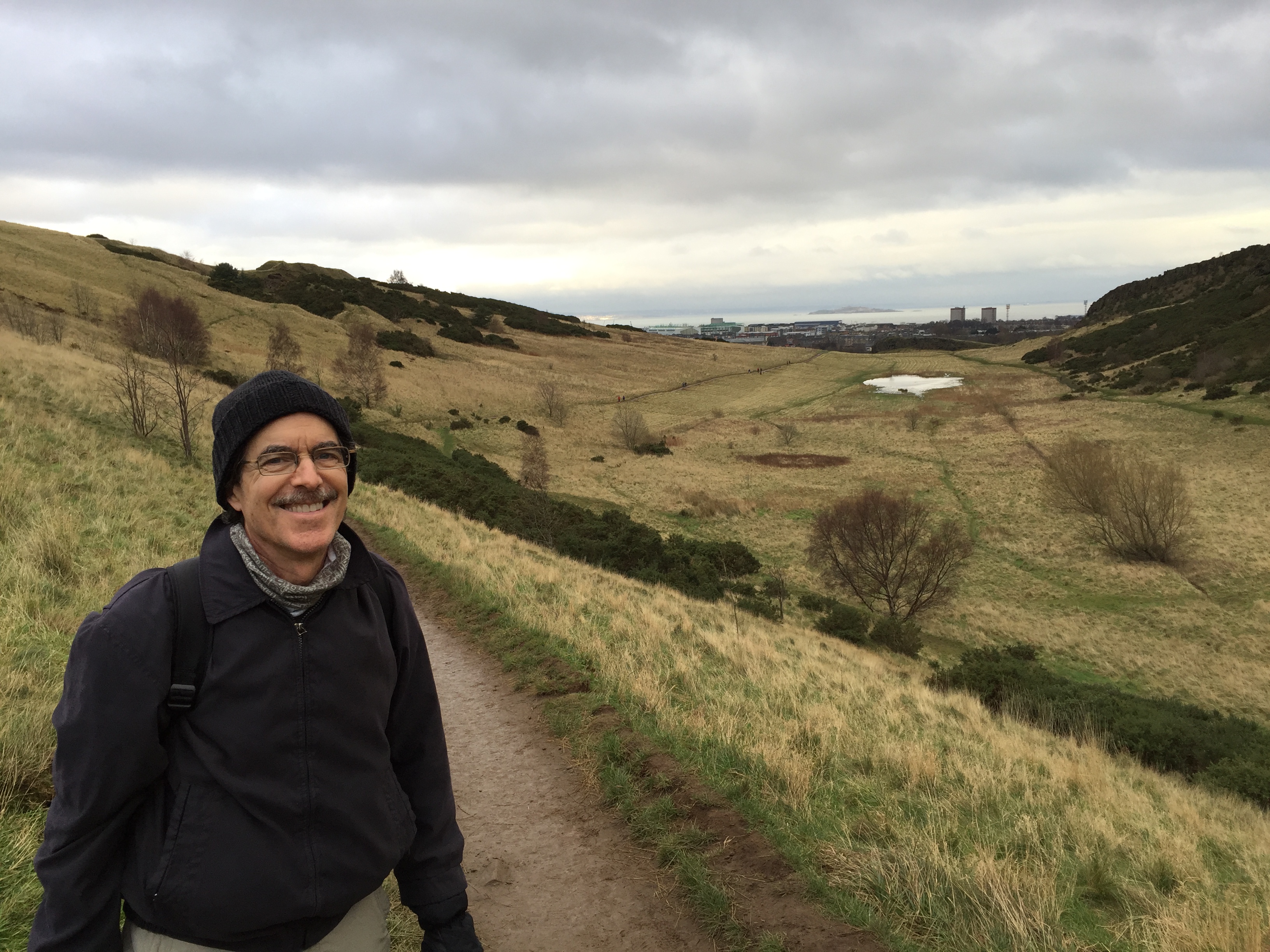
Parks were open today, however, and were rather busy.  We drove to Holyrood Park, aka Queen's Park, and hiked up the hill to Arthur's Seat, an ancient volcano which rises 822 ft above the surrounding area and offers panoramic views of the city and beyond.  Though the trail was muddy from all the recent rain, the climb was greatly facilitated by the gradually sloped path winding up the east side of the hill.
  
Enjoying the climb
Edinburgh's most popular tourist attraction, Holyrood Park was established and opened to the public by James V in 1541. Prior to that the area had served as a 12th century royal hunting estate.  The park was bustling with people on this holiday, about half of whom were accompanied by dogs.  We saw only two dogs on leash.

Back at the hotel, we took advantage of the guest laundry (with tumble dryer!) and walked just down the block to the Sainsbury's Local for a few groceries.  Dinner in the room as we planned the next couple of days before returning home.

SATURDAY, 2 JANUARY 2016 

Even though we found no place for a box, the view is always great.


Friday, January 01, 2016 Road Junkies 0 Comments

GAELIC GETAWAY
, Chapter 26: 
IN WHICH WE GO BACK TO THE SOURCE

Day 32:  Dundee to Edinburgh

The windows of our little Fabia were covered in ice this morning when we went to pack up, delaying our departure from Dundee.  After crossing the River Tay, we drove about 15 miles south on the A-91 to the town of St Andrews on the North Sea coast.  

First chartered in 1170, St Andrews is most widely known as the "home of golf." The Old Course at St Andrews is considered to be the world's oldest course.  It is owned and operated by a public trust.  The Royal and Ancient Golf Club of St Andrews, often considered synonymous with the course, is a private club whose clubhouse sits adjacent to the first tee.  It is just one of many clubs that have playing privileges on the Old Course.  
  
Swilken Bridge over the burn, St Andrews Old Course
Legend has it that the first ever game of golf was played on the links in the early 1400s.  By mid-century, Scottish King James II banned the game because he felt its growing popularity was distracting young men from the practice of archery.  This ban remained in force until his grandson, James IV, became a golfer himself and lifted the restriction.
  
Little resemblance to the smooth nature of US courses
St Andrews is also a college town, home to Scotland's oldest university, which dates back to 1413.  Situated in the middle of town, the campus has buildings throughout St Andrews.  Perennially rated as one of the top universities in the UK, St Andrews on New Year's Day was all but abandoned.  Yet its sense of history and seriousness were still evident, making me wonder if my undergraduate performance would have been better had I benefitted from the inspiration of such a rarefied atmosphere.
   
Architectural style at University of St Andrews lends itself to serious study.
We also checked out the ruins of St Andrews Castle located on a rocky coastal promontory overlooking the North Sea. First built in the early 1200s, the castle became a center of contention in the Wars of Scottish Independence in the 14th century, as it changed hands and was destroyed and rebuilt numerous times.  Finally in 1337, the Scots destroyed the castle to prevent it from again becoming an English stronghold.  
  
St Andrews Castle was built to serve as a luxury residence for the Bishops of Scotland.
Though the castle was rebuilt the following century and eventually became the seat of the archbishop of St Andrews, it was again destroyed during the course of the Scottish Reformation.  After the Catholic church was decommissioned in Scotland in the 1600s, the castle fell into disrepair and became a source of building material for the townspeople.  All that remains today is a portion of the south wall.
  
St Andrews Cathedral
The more impressive ruins in the city are those of St Andrews Cathedral.  Construction on the massive edifice was begun in 1160 and continued for more than 150 years.  Progress was stalled by a 1272 storm, which blew down the west front, and by the first war of independence against England.  Finally in 1318, the cathedral was dedicated in the presence of Scottish King Robert the Bruce.  It was by far the largest church in Scotland and became the headquarters of the Catholic church in Scotland.  

In 1559, a Protestant mob ransacked the cathedral, destroying the interior.   After Catholic mass was banned in the country after the 16th century Scottish Reformation, the cathedral was abandoned and fell into ruin, with its building materials also being repurposed for other structures in the town.

Leaving St Andrews in early afternoon, we followed the coastal road through Crail, Anstruther, Pittenweem, Monance and Elie, where we began to see the large North Sea offshore oil platforms and wind turbines.  By that time, we were looking at 40 miles and an hour and a half to our old familiar Residence Inn in Edinburgh which would have us pushing up against total darkness—not our hearts' desire for driving conditions in a foreign country.

So we turned inland for the last leg of the trip, happy to see light holiday level traffic when we reached the usually busy Edinburgh.  Even the ubiquitous black taxis were in short supply on the streets.  Maybe because their fares double on holidays.  After checking in at the Residence Inn, we learned that our assumptions about restaurant closings on New Year's Day were correct and happily made a big salad for dinner from last night's grocery store haul.

FRIDAY, 1 JANUARY 2016